Vue 2 is Dead, Long Live Vue 2!
Vue 2 is officially no longer supported.

Vue 2 is Dead, Long Live Vue 2!
Vue 2 is officially no longer supported.
Replaced by version 3. A complete rewrite with a quite different architecture.
Personally, I do prefer writing components using the composition API but I’m still grateful for the influence Vue 2 had in modern front-end development.
Let me list what I loved about Vue 2.
Single File Components
Probably my favorite feature was the introduction of Single File Components. HTML, CSS, and Javascript coexist in the same file. It’s like keeping all parts of a puzzle in the same box. This makes components neat and well-organized.
Vue 2 wasn’t the first to do this, but it definitely made it popular.
Vite
While not directly part of Vue, it was created by the same team to address the need for a fast and efficient bundler that doesn’t drive you crazy to configure. It is now framework-agnostic and considered one of the most valuable tools in modern web development, widely adopted by every popular framework for its simplicity and speed.
HTML & CSS
We take both for granted in the Vue world. But I’m really grateful for not inventing an XML version of Javascript to represent the DOM or using something like inline styles, CSS-in-JS, etc.
I know some people like them, but the truth is that… they are wrong. 😅
And don’t even get me started about HTMX.
Better JavaScript knowledge
The logic of a component is written in methods, and methods are just JavaScript functions (or TypeScript if you prefer). To solve a problem you had to write JavaScript and to become a rockstar Vue Developer, learning better JavaScript was the only way. This is a good bet if you want to stay relevant in web development. JavaScript is eating the world after all.
Easy learning curve
As a front-end engineer you probably already know the above HTML, CSS, and JavaScript. What was left was to understand how the Vue Instance worked, learn a few lifecycle hooks and some built-in directives and you were ready to build something with minimal effort. This ease of usage was attributed as the favorite feature of the framework and made many of us switch to it.
Reactivity in-depth explained
The magic of reactive variables always fascinated me even when AngularJS was my framework of choice. But it was only after reading Reactivity in Depth that I started to understand what was happening behind the scenes. This effort made everyone aware of their cost and put performance in mind when using them.
Performance
And performance was definitely in the mind of the core team. There were constant efforts to improve bundle size and the runtime performance of the framework itself with many performance benchmarks between the versions or other frameworks as a guideline.
Opinionated about third-party libraries
It’s probably impossible to create a useful application only by using the Vue Core. Routing, state management, scaffolding, testing, IDE, and browser devtools support are all essential in the real world.
Having clear recommendations for these essential supporting libraries means that everyone is on the same page, support for issues can be found more easily, and synergies between them can flourish.
Conclusion
I wish there was a way to know you’re in the good old days before you’ve actually left them. — Andy Bernard
I like Vue 3 but the retention of Vue 2 feels unreal.
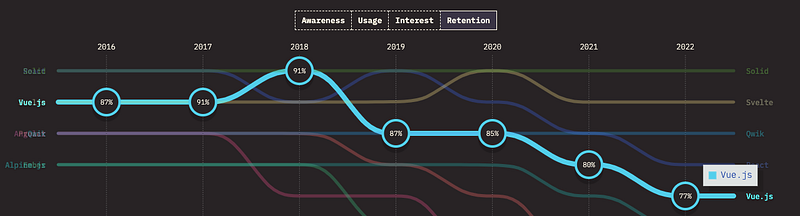
https://2022.stateofjs.com/en-US/libraries/front-end-frameworks/
Somewhere between the nonexistent migration path and the confusion between ref and reactive a lot of traction was lost and it’s highly unlikely that Vue 3 will match the love Vue 2 received.
Now that the pain of working with mixins is slowly forgotten all that’s left is a memory of a solid and predictable framework capable of scaling as needed. Its legacy is invaluable and impacted the foundations of modern front-end development.
Thank you for everything Vue 2. 🫡
Can we go back to Vue 2? No.
Is Vue 3 perfect? No.
Is Vue 3 still the best option for modern application development? YES!